
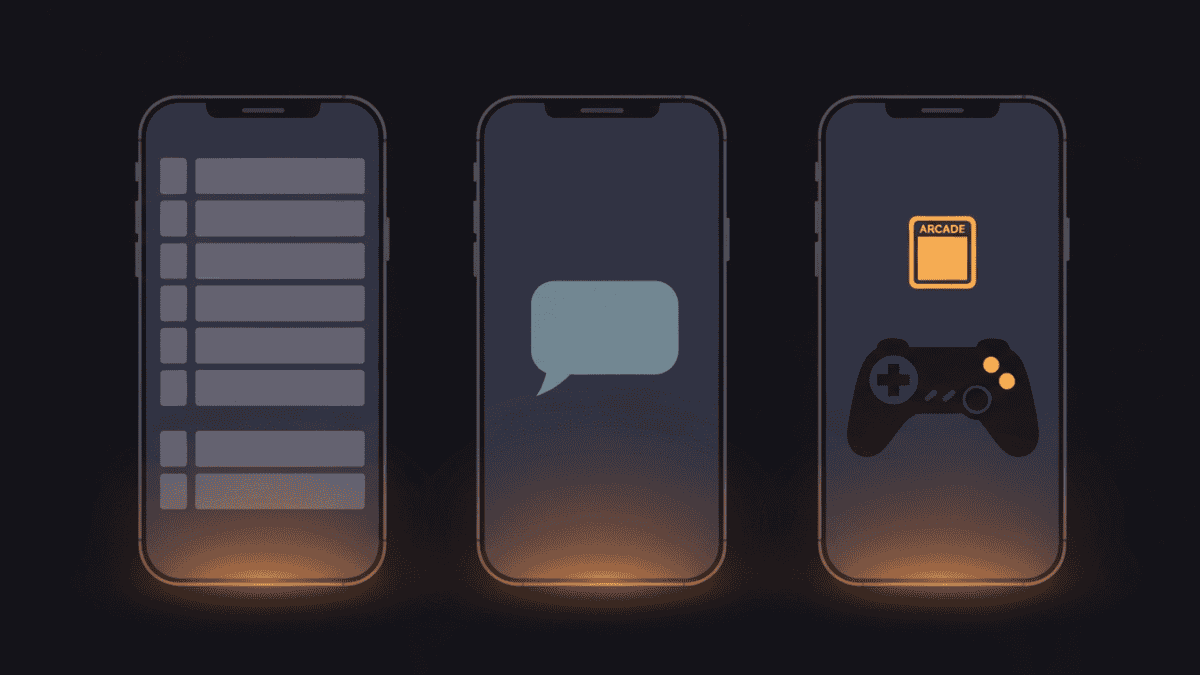
Watch what people actually do with their phones and it collapses into three things: scrolling, messaging, gaming.
I spend a lot of my time thinking about what people do with software at work. But work behaviour is shaped by obligation — you use the tools you’re handed. What people reach for outside work is more revealing, because it’s chosen freely. And the choices are strikingly consistent: a feed to scroll, a thread to reply to, a game to drop into.
What strikes me is how sticky these three are. Platforms, form factors and fashions churn constantly, but the underlying modes don’t. Scrolling, messaging and gaming have survived every reinvention of the phone. They look less like passing habits and more like defaults — the shapes attention naturally takes when you hand someone a glowing rectangle and a few idle minutes.
Call them the three sticky defaults.
Which raises a question I keep circling as we design for the AI era: how much will these behaviours actually change?
It’s tempting to assume AI rewrites the interaction model — that agents and copilots pull people out of feeds and into something more intentional. Maybe. But the more useful bet might be the opposite: treat scrolling, messaging and gaming as durable human defaults, and design with them rather than against them.
Conversational interfaces are interesting precisely here. Text and voice let people drive a tool the way they already drive a chat — no app to open, no menu to learn, just say what you want. There’s a jobs-to-be-done point buried in that: the job was never “learn the app”, it’s “say what you want” — Christensen’s articulation of jobs-to-be-done, from Competing Against Luck. That’s not a new behaviour we have to teach; it’s messaging, pointed at software instead of a person. It also means the tool has to know enough about you to act on a loose ask — which is the design space I’ve been calling the Intent Stack.
So maybe the design question isn’t “how do we change what people do with their devices” — it’s “which of these three sticky defaults can we meet them inside of?” Concretely: an AI surface that lives inside the chat thread or the feed you’re already in, rather than yet another app you have to go and open. And if you could only ship inside one of the three, which would you bet on?
For what it’s worth, here’s the bet I’m making. For the open web to thrive, it may have to conform — to meet people inside these defaults rather than asking them to come to it. That’s the hope behind getclkt.com and atomic assets: a content marketplace — economics, social graph and rights built in — that can carry open-web content into at least the messaging and scrolling modes people already live in.