
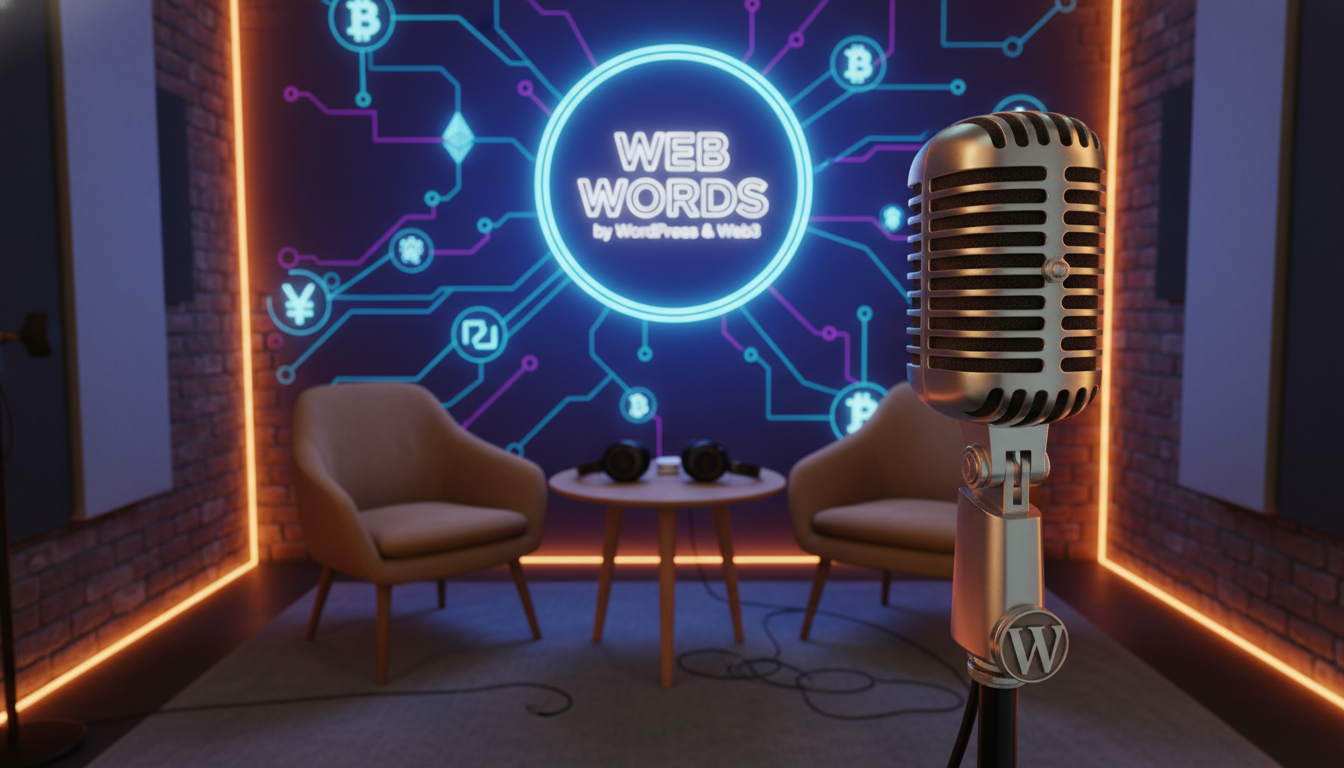
I recorded a podcast with Nathan Wrigley from WP Tavern in early July 2022, just before my WordCamp Europe talk. This was right as I’d joined Automattic as Web3 Lead, and the WordPress community was… let’s say divided… about whether Web3 had any place in WordPress at all.
Nathan gave me 30 minutes to make the case for why these technologies might matter. Not to hype them. Not to promise they’ll revolutionize everything. Just to explain what they are, how they work, and where they might create value for WordPress users.
So yeh. Let me walk you through what we covered.
What Is Web3, Really?
Here’s the definition I gave Nathan: "Web3 is a family of decentralized technologies that allow people to coordinate in new and interesting ways."
The key word is decentralized. Not controlled by a single company, government, or entity. Coordination without centralized authority.
More practically: technologies built on blockchains and related decentralized systems.
That includes:
- Cryptocurrency: Digital money that works without banks
- DAOs: Organizations coordinated by code and token voting
- NFTs: Provably unique digital assets
- Smart contracts: Self-executing agreements
- DeFi: Financial services without intermediaries
I emphasized this distinction because people hear "Web3" and think "Bitcoin price" or "NFT speculation." But the underlying technology is about coordination mechanisms, not just investment vehicles.
Why I’m in This Space
I’ve been in WordPress for 15 years. Started as a freelancer, ran an agency, contributed to the community. WordPress is about democratizing publishing – giving people tools to create and share without gatekeepers.
Web3 is about similar principles applied to finance and coordination.
I got into cryptocurrency in 2017. Not because of price speculation, but because the technology was interesting and the philosophical alignment with open source values felt right.
When Automattic offered me the Web3 Lead role, it made sense. How do these decentralized technologies intersect with a platform that powers 43% of the web? Where’s the value for creators, merchants, and communities?
Those were (and are) the questions I’m exploring.
The WordPress Connection
Nathan asked the crucial question: Why should WordPress care about Web3?
For Creators
Direct monetization: Creators can mint articles as NFTs, earn from sales, capture secondary market royalties. No platform taking 30% cuts.
Token-gated content: Premium content accessible only to NFT holders or token owners. Membership without subscription platforms.
Crypto payments: Tips, patronage, payments – direct wallet-to-wallet. Especially valuable for international creators dealing with expensive payment processors.
I mentioned platforms like WordProof that use blockchain timestamping for content verification. Prove ownership, detect plagiarism, establish publishing timestamps. Practical utility that exists today.
For Merchants (WooCommerce)
Accept cryptocurrency: Lower fees than credit cards, especially for international transactions. Stablecoins solve the volatility problem.
NFT loyalty programs: Give customers unique tokens that unlock discounts, early access, exclusive products. Transferable, tradeable, provably scarce.
Token-gated commerce: Limit product access based on token ownership. Prevent bot purchases of limited releases. Reward community members.
Sell digital collectibles: Sports teams selling digital trading cards. Artists selling limited editions. New product categories.
For Communities
DAOs for governance: WordPress communities coordinating through token voting. Treasury management on-chain. Transparent decision-making.
Reputation systems: Contributions tracked via tokens or NFTs. Portable reputation across platforms. Provable expertise.
Collaborative ownership: Plugins or themes owned by DAOs. Contributors earn tokens. Collective decision-making about direction.
Addressing the Skepticism
Nathan didn’t let me off easy. He pushed on the valid concerns:
"It’s All Speculation"
I acknowledged this head-on. Yes, crypto markets experience wild price swings. Yes, there’s speculation and scams.
But: speculation and underlying technology are different things.
The internet bubble burst in 2000. Lots of garbage companies went to zero. But Amazon, Google, and actual useful internet services survived and thrived.
Crypto follows similar patterns. Market cycles – enthusiasm, correction, recovery with better use cases. The speculation doesn’t invalidate the technology.
"The Learning Curve Is Too Steep"
True. Wallets, private keys, gas fees, seed phrases – it’s complex and scary for normal people.
This is actually where WordPress can help. WordPress made web publishing accessible by abstracting complexity. "You don’t need to know PHP to use WordPress."
Same opportunity with Web3: Abstract the complexity. Users don’t need to understand blockchain internals to use crypto payments or own NFTs. They just need tools that work.
"What’s the Killer App?"
I was honest: I don’t know yet. Maybe there isn’t one singular killer app.
Most people don’t understand how email works (SMTP, POP3, IMAP). They just know it works. Same with Web3 – the breakthrough might not be obvious. It might just be utility that makes people’s lives better.
But I pointed to real examples:
- Migrant workers sending remittances home for pennies instead of 10% Western Union fees
- Artists earning living wages from NFT sales when Spotify pays fractions of a cent
- People in countries with unstable currencies preserving value in stablecoins
These aren’t hypothetical. They’re happening now.
WordPress.org vs WordPress.com
We talked about the complementary model – centralized and decentralized coexisting.
WordPress.org: Decentralized, open source, community-governed (mostly).
WordPress.com: Centralized platform built on that open source core. Hosting, support, ease of use.
Both have value. Users choose based on needs.
Same with Web3 and Web2. Centralization offers efficiency and user experience. Decentralization offers ownership and censorship resistance. Not either/or – complementary opposites.
What Automattic Is (and Isn’t) Doing
My mandate at Automattic:
Education: Increase Web3 understanding in the WordPress community. Provide context, not hype.
Exploration: Find touchpoints where Web3 creates value for creators and merchants. Not forcing anything, identifying opportunities.
Research: Crypto payments, NFT integrations, decentralized identity. What makes sense? What’s premature?
Community: Work with organizations like BIMA (British Interactive Media Association) and the Blockchain Council. Build bridges between communities.
What I’m NOT doing: Forcing Web3 on anyone, promising it solves everything, ignoring valid criticism.
Geopolitics and Permissionless Systems
One point I emphasized: permissionless protocols matter more during geopolitical instability.
When centralized systems face sanctions, banking restrictions, or government control, alternative value transfer systems become crucial.
Cryptocurrency doesn’t require permission. You don’t need a bank account. You don’t need government approval. You just need an internet connection and a wallet.
For people in Venezuela, Argentina, Lebanon – places with hyperinflation or banking crises – this isn’t ideological. It’s practical survival.
WordPress users are global. The Web3 tools that seem unnecessary in stable Western countries might be essential elsewhere.
The Gatekeeping Problem
I acknowledged a painful truth: Web3 communities can be incredibly gatekeep-y and exclusionary.
Jargon, in-jokes, assumption of knowledge, hostility to newcomers asking basic questions. It creates barriers to entry that contradict the "permissionless" rhetoric.
WordPress got this right. The WordPress community is (generally) welcoming. Documentation is accessible. People help newcomers.
If Web3 is going to reach mainstream adoption, that culture needs to change. Or platforms like WordPress need to build the bridges that make it accessible despite the gatekeeping.
What I Learned
Doing this podcast forced me to articulate clearly why I think Web3 and WordPress could work together.
Not "should" – there’s no mandate. Not "must" – forced adoption won’t work. But "could" – the alignment of values and potential for creator empowerment is real.
Nathan’s skeptical questions were valuable. They made me think through the weaknesses, address the valid concerns, separate hype from utility.
The WordPress community doesn’t need Web3 hype. It needs honest assessment, practical use cases, and tools that solve real problems without creating new ones.
That’s what I tried to provide in 30 minutes. Whether I succeeded… well, listen and judge for yourself.
Resources Mentioned
During the podcast I recommended several learning resources:
Kernel: Educational platform for Web3 learning. Thoughtful, philosophical approach rather than just technical tutorials.
RabbitHole: Gamified Web3 education. Learn by doing, earn rewards for completing on-chain tasks.
WordProof: Blockchain timestamping for WordPress content. Practical utility, available now.
Blockchain Council (BIMA): Community I co-chair, focused on educating UK agencies and brands about blockchain/Web3.
Looking Back From 2025
Recording this podcast in July 2022, I was three months into my Automattic role. Still figuring out what Web3 at scale could mean. The market was crashing (again). Skepticism was high.
Some predictions held up. Creator monetization through NFTs has matured. Crypto payments have grown. Token-gating is increasingly common.
Some didn’t. The "killer app" I couldn’t name still doesn’t exist (or hasn’t been recognized as such). Mainstream adoption is slower than enthusiasts hoped.
But the fundamental thesis remains: decentralized technologies create options for coordination and value transfer that centralized systems don’t.
Whether those options matter to enough people to justify the complexity cost – that’s still being figured out.
Thanks to Nathan for the thoughtful conversation and for giving Web3 a fair hearing in the WordPress community.
Podcast: WP Tavern – Episode #33
Title: David Lockie on Why Web3 and WordPress Might Work Together
Host: Nathan Wrigley
Date: July 6, 2022
Duration: ~30 minutes
Listen: WP Tavern
Also available on: Apple Podcasts
Find me: Contact form, @divydovy most places, hi@divydovy.com
Note: This podcast was recorded shortly before my WordCamp Europe 2022 talk on the same topic. If you want the long-form, slide-deck version of these ideas, check that talk out too. These are my personal views, not official Automattic positions.