
So yeh. This is the third (and final) post in the There Is No Host series.
The first post argued that hosting creates unnecessary friction. The second post explored how permissioned infrastructure has been essential to unlocking software value, but concluded that freedom must be translated into meaningful products and experiences to drive growth.
This post aims to demonstrate how freedom can be operationalized by leveraging emerging technologies. By connecting abstract freedom principles to concrete, impactful capabilities, open-source platforms can differentiate and grow.
Economic freedom underpins all global progress. We want to increase economic freedom globally.
— Brian Armstrong, Coinbase CEO
This aligns with the open-source mission to enhance digital freedoms through software offerings.
As Matt Halstead from the Teacher Retirement System of Texas states, "Crypto is the merger of communications networks and financial networks." This intersection opens new avenues for enhancing user freedom.
The Mental Models Behind Freedom Stacks
I’m synthesizing several frameworks to explore how freedom can be operationalized:
-
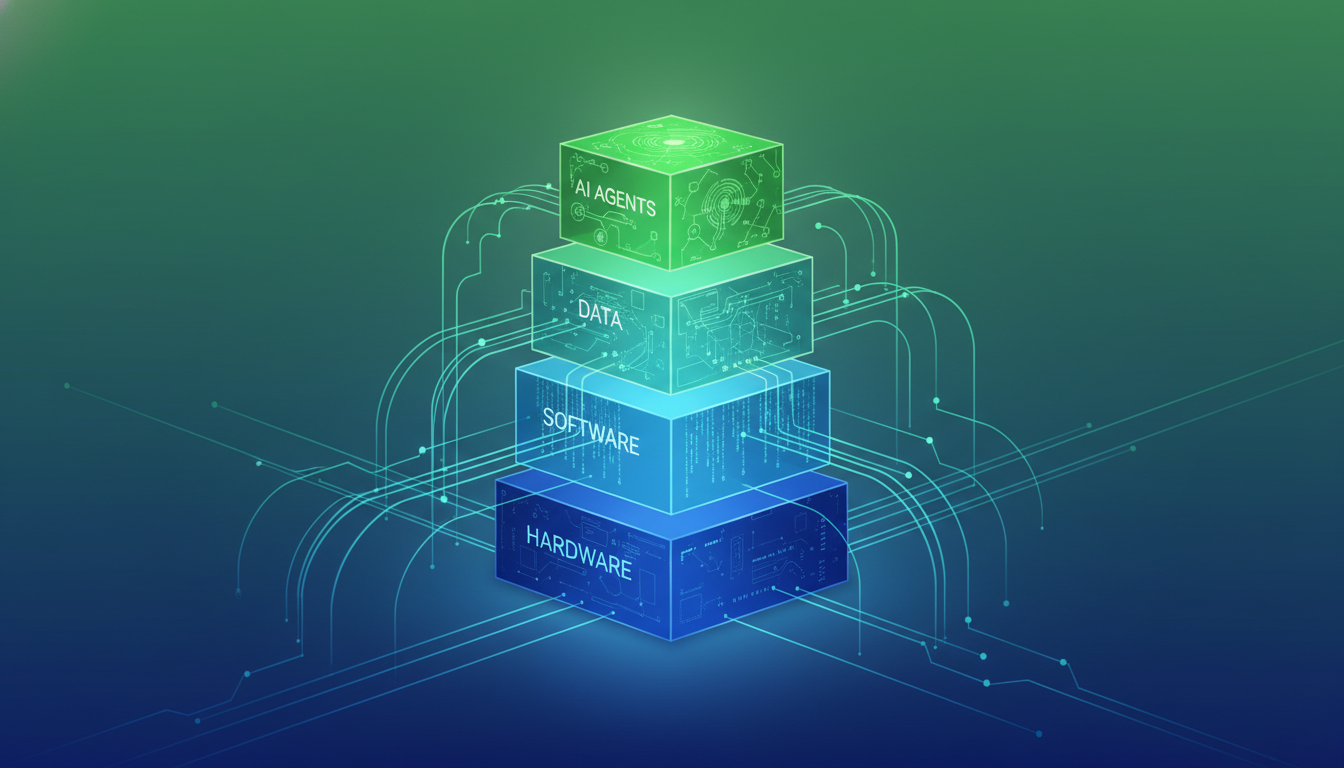
Systems Thinking – Breaking platforms into layers (hardware, software, data, agents) to identify where freedom can be maximized at each level. Understanding how freedoms at one layer enable freedoms at higher layers.
-
Commoditize Your Complements (Joel Spolsky) – If you can make the layers below you free and open, you capture more value at your layer. This explains why open-source platforms benefit from decentralized infrastructure.
-
Jobs-to-be-Done (Clayton Christensen) – Users aren’t hiring platforms for features—they’re hiring them for outcomes. Freedom matters only when it enables better outcomes (ownership, portability, control).
-
Composability (Chris Dixon, a16z) – When you own the components, you can recombine them in novel ways that centralized systems can’t match. Freedom enables composability.
-
Disruptive Innovation (Clayton Christensen) – Decentralized alternatives start simple (serving overlooked use cases), improve rapidly, then move upmarket to displace incumbents.
-
Hyperstructures (Jacob Horne) – Protocols that run indefinitely without maintenance or intermediaries, creating unstoppable public goods. These represent maximum freedom at the infrastructure layer.
The synthesis reveals something critical: freedom isn’t just philosophical—it’s a systematic competitive strategy. Small freedoms compound into larger freedoms, creating defensible advantages.
Which Freedoms Matter?
Let’s brainstorm key freedoms that matter in the digital realm. As both software users and creators, these should resonate:
Infrastructure & Access:
- Freedom to access the internet
- Freedom to run software without paying corporations
- Freedom to control your own identity
- Freedom to manage your social graph and relationships
Data & Privacy:
- Freedom to decide how to share your data and with whom
- Freedom to understand and manage data collection
- Freedom to delete your data
- Freedom to download your data or avoid unnecessary collection
- Freedom to decline corporate terms of service and have viable alternatives
Financial & Economic:
- Freedom to transact with anyone, anywhere, anytime
- Freedom to manage your own risk
- Freedom to choose partners for protection and information security
Creative & Expression:
- Freedom to publish and distribute content without artificial throttling or predatory monetization
- Freedom to create, own, and license your creations
Technological:
- Freedom to train open-source AI models that act in your interests
- Freedom to choose applications for orchestrating your digital activities
Some of these freedoms exist within open-source ecosystems today, but they often lack contextual relevance and meaningful impact. In the previous post, I discussed freedoms that platforms offer but inadvertently undermine.
These freedoms must align with the rule of law in any locale. There is existing work on digital rights we can consider, but my intention here is to encourage creative thinking about possibilities, not to finalize them yet.
Operationalizing Freedom: The Layers
Computer systems rely on fundamental components: hardware, software, data, and increasingly, agents (AI, bots, algorithms). What would dialing freedom up to 9 or 10 look like at each level?
Hardware (Infrastructure)
Current State: Most users rent infrastructure from large cloud providers (AWS, Google Cloud, Azure) with little control or transparency.
Freedom-Maximized Future:
- Use decentralized infrastructure to power sites using serverless stacks
- Participate in DePIN (Decentralized Physical Infrastructure Networks) for storage, compute, and networking
- Unbundle infrastructure services to make them more composable and user-controlled
- Explore hyperstructures—protocols that run indefinitely without maintenance or intermediaries
Software
Current State: Plugin/theme ecosystems suffer from incompatibility, abandonment, and quality inconsistencies.
Freedom-Maximized Future:
- Guarantee any plugin/theme combination won’t break sites (enforced compatibility standards)
- Provide mechanisms to take over abandoned plugins (community stewardship)
- Offer bounties for contributions to open-source projects
- Facilitate clearer governance for open-source projects
Data
Current State: Data locked in permissioned databases controlled by platforms. "Data Liberation" initiatives help, but require manual export.
Freedom-Maximized Future:
- Allow users to store data on-chain rather than in permissioned databases (posts as NFTs, likes as tokens, social graphs as wallet relationships)
- Data never needs liberation because it’s already free—users own keys, platforms provide interfaces
- Explore ways to make liberated data from social platforms valuable and portable
Agents (AI, Bots, Algorithms)
Current State: Users rely on closed AI models (ChatGPT, Claude, Gemini) with no control over training data, behavior, or privacy.
Freedom-Maximized Future:
- Integrate open-source AI models to provide users with private, secure AI
- Offer mechanisms for users to manage and fund autonomous AI agents on their behalf
- Enable personal AI trained on user data with full privacy guarantees
Concrete Examples: Dialing Up Freedom
What would specific product categories look like with freedom dialed to 10?
Email & Communication Tools
Instead of: Traditional email marketing platforms that lock users into proprietary systems
Freedom-Maximized:
- Integrate ability for creators to send money or tokens via email (TipLink, Coinbase Send)
- Support peer-to-peer encrypted protocols (XMTP, Matrix)
- Allow portability of audience data across platforms
Content Creation Platforms
Instead of: Platforms that force users to build full websites just to publish content
Freedom-Maximized:
- Offer freedom from needing a whole website—allow use as single-post content creator
- Enable portable identity so content follows users across platforms
- Support federated distribution (ActivityPub, AT Protocol)
Ecommerce Platforms
Instead of: Closed ecommerce systems with vendor lock-in
Freedom-Maximized:
- Provide users with digital wallets for peer-to-peer and peer-to-merchant payments over crypto or open rails
- Enable portable product catalogs that work across platforms
- Support composable commerce—users assemble best-of-breed components
Cross-Platform Freedom Opportunities
Maximizing freedom for individual products should create opportunities for freedom across product portfolios. Examples:
Audience Portability:
- Build an audience on one platform, sell on another, communicate via a third—but it’s the same audience, not separate silos
- "The audience you build is the last one you’ll ever need to build"
Capability Marketplaces:
- Allow users to access raw capabilities (content creation, spam detection, SEO optimization) to build new products without permission
- Think "AWS-ification" of platform capabilities—atomic, API-accessible services
Open Identity:
- Enable users to bring their own identity via open protocols (did:web, ENS, Handshake)
- No more creating separate accounts for every service
Gutenberg as Example:
Block-based content creation was supposed to fundamentally shift WordPress from document model to atomic building blocks that could construct almost anything.
Currently, Gutenberg hasn’t realized this potential. Most users primarily create web page documents. What if Gutenberg blocks could:
- Be used outside WordPress (portable block standard)
- Compose any type of digital experience, not just websites
- Be traded/sold as NFTs or composable components
Freedom Beyond Single Platforms
WordPress has a natural market share limit. How can freedom principles extend impact beyond any single ecosystem?
Permissionless Protocols:
- Create or participate in open protocols and standards that keep the web open
- Examples: ActivityPub, AT Protocol, Matrix, IPFS, Arweave
Universal Revenue Participation:
- Generate revenue not just from specific platform stores, but from every web store that uses open standards
- Think protocol-level monetization (0.1% fee on all commerce using open commerce protocol)
Federated Distribution:
- Enable creators to distribute products and content beyond single platform channels to the entire fediverse
- Content published once, distributed everywhere
The Concept of Freedom Stacks
I first encountered "Freedom Stack" in this podcast and found it compelling. The phrase has dual meaning:
1. Technology Stacks That Preserve Freedom
A Freedom Stack is a technology architecture that preserves freedom at multiple levels:
┌─────────────────────────────────────┐
│  User Interface Layer               │
│  (Freedom to choose apps/clients)   │
├─────────────────────────────────────┤
│  Application Layer                  │
│  (Freedom to run own AI/agents)     │
├─────────────────────────────────────┤
│  Data Layer                         │
│  (Freedom to own/port data)         │
├─────────────────────────────────────┤
│  Infrastructure Layer               │
│  (Freedom to choose hosting/compute)│
└─────────────────────────────────────┘
At each layer, users have genuine choice and control. No single vendor lock-in.
2. Individual Freedoms That Stack to Enable Greater Freedoms
Small freedoms compound into larger, more impactful freedoms:
- Freedom to own data + Freedom to port identity = Freedom to switch platforms without friction
- Freedom to transact globally + Freedom to publish content = Freedom to monetize anywhere
- Freedom to run open AI + Freedom to own training data = Freedom from algorithmic manipulation
Platforms that operate across hardware, software, data, and agent layers have unique opportunities to build freedom into every offering, allowing freedoms to stack and compound.
Real-World Example: Creator Monetization
Here’s a practical example of freedom stacking enabling new value:
Traditional Model (Low Freedom):
- Creator publishes on Platform X
- Platform X controls distribution (algorithmic feed)
- Platform X controls monetization (ads, subscriptions via platform)
- Platform X owns audience relationship
- If creator leaves, loses everything
Freedom Stack Model (High Freedom):
- Creator publishes to open protocol (ActivityPub, AT Protocol)
- Content distributed to any compatible client (no algorithmic gatekeeping)
- Monetization via direct crypto payments, NFT sales, or open payment protocols
- Audience relationships stored in portable social graph (creator owns keys)
- If creator switches clients/platforms, keeps everything
Real examples: Nyan Cat creator monetization, Beeple’s $69M NFT sale.
Looking Forward: Possible Scenarios for 2025-2026
Thinking ahead 18 months from publication, here are scenarios that might unfold:
What Could Change:
- Decentralized infrastructure (DePIN) could mature significantly—Filecoin, Arweave, Akash Network becoming more production-ready
- Open AI models (Llama, Mistral, Qwen) might become genuinely competitive with closed alternatives
- ActivityPub adoption could accelerate (Meta’s Threads federating, Tumblr implementing)
- Crypto payment rails might stabilize (stablecoins, Lightning Network)
What Might Not Change:
- Most users still don’t prioritize "freedom" when choosing platforms
- Centralized platforms still dominate despite decentralized alternatives existing
- The tension between convenience and control remains unresolved
- Open-source platforms still struggle to monetize at scale
New Developments:
- AI agents are now real—autonomous systems executing tasks, requiring payment infrastructure
- Industry discussions about AI agent payment protocols show this as an active area of innovation
- "Freedom Stack" as framework has been adopted by some Web3 projects
The Challenge Remains:
Freedom as philosophical value ≠ Freedom as competitive advantage. The work of translating values into differentiated products continues.
Where I Might Be Wrong
This analysis assumes several things that could turn out to be incorrect:
I’m assuming that users will prioritize freedom over convenience once they understand the value proposition. But decades of centralized platform dominance suggest that most users don’t deeply care about data ownership, portability, or algorithmic transparency—they just want things to work. If convenience continues to trump freedom in purchasing decisions, freedom-maximized products might remain niche.
I’m assuming that decentralized infrastructure (DePIN, IPFS, Arweave) will mature to production-ready quality. If these technologies remain complex, expensive, or unreliable compared to AWS and Google Cloud, the freedom stack becomes theoretical rather than practical. Technical limitations could keep freedom-focused alternatives in the "interesting experiment" phase indefinitely.
I’m assuming that the economics work—that platforms can capture enough value from freedom-based offerings to justify the investment. But if users won’t pay premiums for freedom features, and if decentralization increases costs rather than decreasing them, the business model might not close. Centralized platforms might simply have insurmountable efficiency advantages.
I’m assuming the timeline I’m projecting is realistic. Christensen’s disruption playbook shows that technological transitions often take longer than proponents expect. The shift to freedom-maximized systems could be decades away, not years—or might never reach mainstream adoption at all.
An alternative view would emphasize that centralized platforms provide real value through curation, moderation, and network effects that decentralized alternatives struggle to replicate. The "walled garden" might not be a bug but a feature—users might genuinely prefer managed experiences over the responsibility of self-custody and self-governance.
I could be wrong about composability being inherently valuable. More components and more freedom might just mean more complexity and more ways for things to break. The iPhone succeeded partly by limiting freedom and controlling the experience tightly. Sometimes "it just works" beats "you can customize everything."
If I’m overestimating user demand for freedom, or underestimating the technical and economic challenges of decentralized alternatives, then freedom stacks remain an interesting thought experiment rather than a competitive strategy. But understanding the direction—even if the timeline or adoption curve is uncertain—still helps inform platform decisions today.
Conclusion
This post has explored operationalizing freedom in digital products. It suggests various levels at which freedoms matter and how these ideas might manifest in concrete features and architectures.
By building and compounding freedoms across hardware, software, data, and agent layers, platforms can create, protect, and strengthen fundamental freedoms that shape daily digital experiences.
This post doesn’t claim to have all the answers—it aims to provoke better questions:
- Which freedoms actually drive purchasing decisions?
- How can abstract freedom principles become tangible features?
- What does "freedom dialed to 10" look like for your product?
- How can small freedoms stack into game-changing capabilities?
The open-source community has earned the right to tell the freedom story. The challenge is translating that story into products people choose.
Note: This essay was originally written as internal thought leadership exploring how freedom principles could be operationalized across a platform portfolio. I’ve adapted it for public discussion about open-source competitive strategy. Many company-specific product examples have been generalized to universal patterns. The core framework—examining freedom at hardware/software/data/agent layers and thinking about freedom stacking—applies broadly to any open-source platform considering differentiation strategy.
Series Navigation:
- Part 1: There Is No Host – Why WordPress needs to hide the plumbing
- Part 2: On Software and Freedom – The inverse relationship between value and freedom
- Part 3: Freedom Stacks (this post) – Operationalizing freedom through technology stacks
Further Reading:
- The Innovator’s Dilemma – Clayton Christensen on disruption theory
- What Is Disruptive Innovation? – Harvard Business Review
- Competing Against Luck – Clayton Christensen on Jobs-to-be-Done
- ActivityPub Protocol – Open social networking protocol
- Arweave – Permanent decentralized storage
- Hyperbolic – Open access AI cloud
- Hyperstructures – Crypto protocols that run indefinitely
- Digital Rights (Wikipedia)